Newsletters
Stay updated with our latest news, insights, and company updates. Explore our collection of newsletters below.
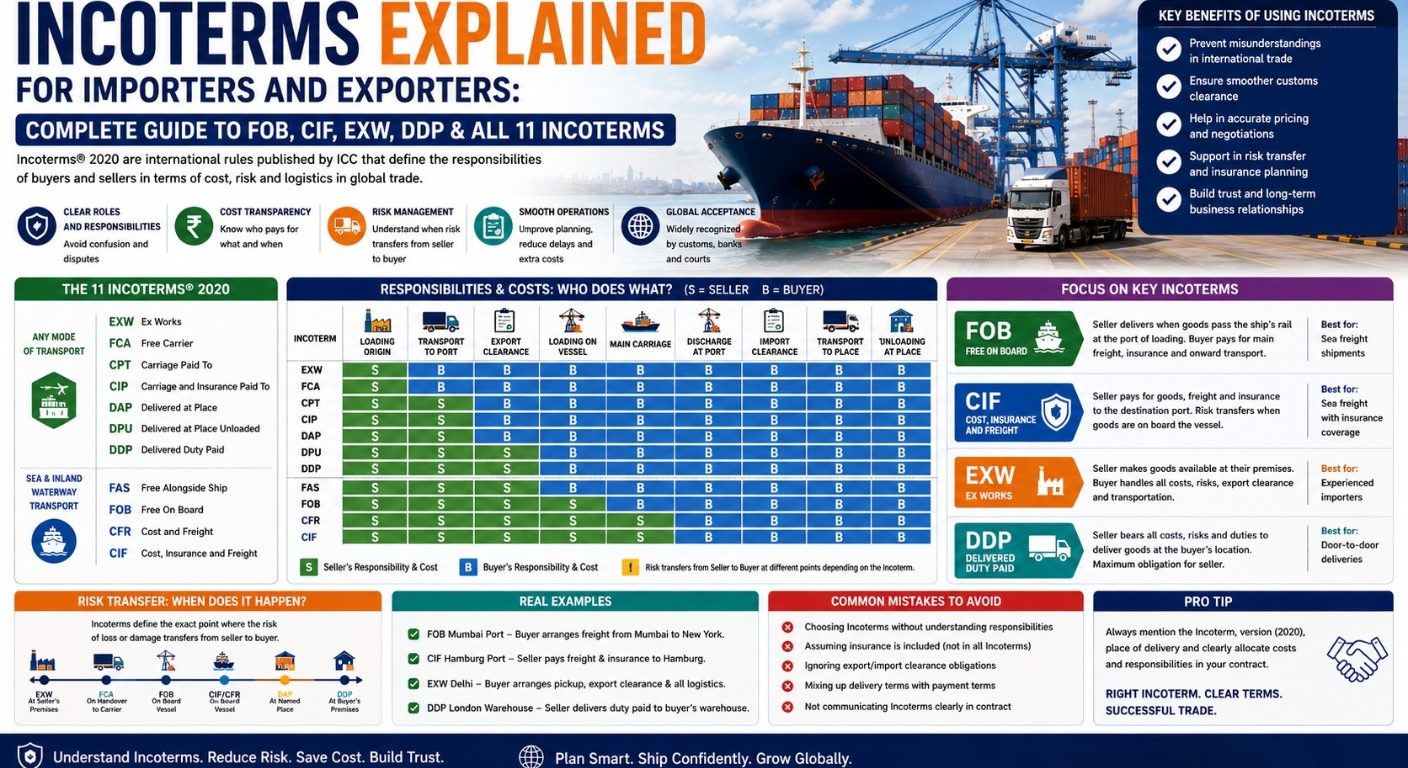
INCOTERMS Explained for Importers and Exporters: Complete Guide to FOB, CIF, EXW, DDP & All 11 Incoterms
Topic: INCOTERMS
INCOTERMS Explained for Importers and Exporters: Complete Guide to FOB, CIF, EXW, DDP & All 11 Incoterms
Introduction
International trade involves much more than moving goods from one country to another. Every shipment requires clear agreements about who pays for transportation, who arranges customs clearance, who purchases insurance, and when the risk transfers from the seller to the buyer.
This is where Incoterms 2020 play a vital role.
Published by the International Chamber of Commerce (ICC), Incoterms (International Commercial Terms) are globally recognized rules that define the responsibilities of buyers and sellers involved in international trade. Whether you are exporting engineering goods from India, importing machinery from Europe, or shipping consumer products to the Middle East, selecting the correct Incoterm helps prevent misunderstandings, unexpected costs, shipment delays, and legal disputes.
In this comprehensive guide, you'll learn about all 11 Incoterms 2020, understand the responsibilities of both parties, identify when risk transfers, know who arranges insurance, review practical industry examples, avoid common mistakes, and compare each Incoterm using an easy-to-understand table.
Problem Statement
One of the most common reasons for disputes in international shipping is the misunderstanding of Incoterms.
Many importers and exporters mistakenly believe that the party paying for freight is also responsible for the cargo until delivery. Others assume that insurance automatically covers every shipment or that customs responsibilities are always handled by the exporter.
These misunderstandings often result in unexpected logistics costs, delays in customs clearance, cargo damage disputes, incorrect freight quotations, lost business relationships, and financial losses.
For example, many businesses believe that under CIF (Cost, Insurance and Freight), the seller remains responsible until the cargo reaches the destination port. In reality, although the seller pays for freight and insurance, the risk transfers much earlier—when the goods are loaded onboard the vessel at the port of shipment.
Understanding Incoterms correctly helps businesses avoid these costly mistakes.
What Are Incoterms?
Incoterms are standardized international trade rules created by the International Chamber of Commerce (ICC). They define the obligations of buyers and sellers regarding transportation, delivery, customs clearance, risk transfer, and insurance.
Incoterms clarify who arranges transportation, who pays transportation costs, who completes export customs formalities, who completes import customs formalities, who purchases cargo insurance, when responsibility transfers, and when the risk passes from seller to buyer.
However, Incoterms do not determine ownership of goods, payment methods, currency, product quality, contract terms, or transfer of title. These matters are covered separately within the sales agreement.
Why Are Incoterms Important?
Using the correct Incoterm provides several benefits such as reducing misunderstandings between buyers and sellers, improving shipment planning, clarifying logistics responsibilities, preventing hidden transportation costs, simplifying freight quotations, reducing legal disputes, and enhancing customer confidence.
Whether you are a manufacturer, exporter, importer, freight forwarder, customs broker, or NVOCC, understanding Incoterms is essential for successful international trade.
The 11 Incoterms 2020 Explained
1. EXW (Ex Works)
Meaning
EXW is the Incoterm with the minimum responsibility for the seller. The seller simply makes the goods available at their premises, and the buyer assumes responsibility for almost everything else.
Seller Responsibilities
The seller is responsible for manufacturing the goods, packaging the shipment, and making the goods available for collection at their premises.
Buyer Responsibilities
The buyer is responsible for loading cargo, inland transportation, export customs clearance, ocean or air freight, cargo insurance, import customs clearance, duties and taxes, and final delivery.
Risk Transfer
Risk transfers to the buyer once the goods are made available at the seller's premises.
Insurance
The buyer arranges insurance if required.
Best Used For
EXW is best used for domestic sales, experienced international buyers, and buyers with strong logistics capabilities.
Example
A textile manufacturer in Ahmedabad sells cotton fabric under EXW terms. The overseas buyer arranges trucking to Mundra Port, export customs, sea freight to Dubai, insurance, and final delivery.
2. FCA (Free Carrier)
FCA requires the seller to deliver the goods to a carrier nominated by the buyer. The seller is responsible for export customs clearance and delivery to the carrier, while the buyer handles main transportation, insurance, import customs clearance, and local transportation. Risk transfers when the goods are handed over to the carrier. FCA is best used for containerized shipments and multimodal transport.
3. FAS (Free Alongside Ship)
Under FAS, the seller delivers the goods alongside the vessel at the port of shipment. The seller handles inland transportation, export customs clearance, and delivery alongside the vessel, while the buyer is responsible for loading cargo onboard, ocean freight, insurance, and import clearance. Risk transfers when the cargo is placed alongside the vessel. This term is commonly used for bulk cargo such as grain, coal, steel, and heavy equipment.
4. FOB (Free On Board)
FOB is one of the most widely used Incoterms for sea freight. The seller is responsible for inland transportation, export customs clearance, and loading cargo onboard the vessel. The buyer handles ocean freight, marine insurance, destination charges, import customs, and local transportation. Risk transfers once the cargo is loaded onboard the ship. The buyer usually arranges cargo insurance.
For example, an exporter in Gujarat ships ceramic tiles to Dubai under FOB Mundra. The exporter pays all costs until the containers are loaded onboard the vessel, after which the buyer arranges freight, insurance, customs clearance, and inland delivery in the UAE.
5. CFR (Cost and Freight)
Under CFR, the seller pays the ocean freight but does not arrange insurance. The seller is responsible for inland transportation, export customs clearance, and ocean freight, while the buyer handles insurance, import customs clearance, destination charges, and local transportation. Risk transfers when goods are loaded onboard the vessel.
6. CIF (Cost, Insurance and Freight)
CIF is commonly used for international sea shipments. The seller is responsible for export customs clearance, ocean freight, and cargo insurance, while the buyer handles import customs clearance, duties and taxes, and local transportation. Risk transfers once the goods are loaded onboard the vessel. The seller purchases marine insurance for the buyer's benefit.
For example, an Indian rice exporter ships cargo to Kenya under CIF Mombasa. The exporter pays for freight and insurance, but if cargo is damaged during the voyage, the buyer files a claim under the insurance policy because the risk transferred when the cargo was loaded onto the vessel.
7. CPT (Carriage Paid To)
Under CPT, the seller pays transportation to the agreed destination and handles transportation costs and export customs clearance. The buyer is responsible for insurance and import customs clearance. Risk transfers once goods are handed over to the first carrier. CPT is suitable for road, rail, air, and multimodal transportation.
8. CIP (Carriage and Insurance Paid To)
CIP is similar to CPT but requires the seller to arrange cargo insurance. The seller is responsible for transportation, export clearance, and insurance, while the buyer handles import customs, duties, and final delivery. Risk transfers when the first carrier receives the goods. CIP is best used for high-value shipments requiring stronger insurance coverage.
9. DAP (Delivered at Place)
Under DAP, the seller delivers goods to the agreed destination ready for unloading. The seller handles transportation, export customs, and freight, while the buyer is responsible for import customs, duties, and unloading. Risk transfers when the goods arrive at the named destination before unloading.
10. DPU (Delivered at Place Unloaded)
DPU is the only Incoterm requiring the seller to unload the cargo. The seller is responsible for transportation, export customs, freight, and unloading, while the buyer handles import customs and duties. Risk transfers after unloading at the agreed destination. It is commonly used for project cargo, industrial machinery, and oversized equipment.
11. DDP (Delivered Duty Paid)
DDP places the maximum responsibility on the seller. The seller handles inland transportation, export customs, freight, import customs, duties and taxes, and final delivery, while the buyer simply receives the goods. Risk transfers when the goods are delivered to the buyer's premises.
For example, a German machinery manufacturer ships production equipment directly to an Indian factory under DDP terms, arranging transportation, customs clearance, duties, and final delivery.
Responsibilities Under Different Incoterms
| Incoterm | Export Customs | Freight | Insurance | Import Customs | Final Delivery |
|---|---|---|---|---|---|
| EXW | Buyer | Buyer | Buyer | Buyer | Buyer |
| FCA | Seller | Buyer | Buyer | Buyer | Buyer |
| FAS | Seller | Buyer | Buyer | Buyer | Buyer |
| FOB | Seller | Buyer | Buyer | Buyer | Buyer |
| CFR | Seller | Seller | Buyer | Buyer | Buyer |
| CIF | Seller | Seller | Seller | Buyer | Buyer |
| CPT | Seller | Seller | Buyer | Buyer | Buyer |
| CIP | Seller | Seller | Seller | Buyer | Buyer |
| DAP | Seller | Seller | Optional | Buyer | Seller |
| DPU | Seller | Seller | Optional | Buyer | Seller |
| DDP | Seller | Seller | Seller/Optional | Seller | Seller |
Understanding Risk Transfer
One of the biggest misconceptions in international trade is assuming that whoever pays for transportation also carries the risk throughout the journey. This is incorrect. For example, under CIF, the seller pays for ocean freight and insurance, but the risk transfers to the buyer as soon as the cargo is loaded onto the vessel. Understanding the distinction between cost responsibility and risk transfer is critical when negotiating international contracts.
Insurance Under Incoterms
Insurance requirements vary depending on the selected Incoterm. Under EXW, FCA, FOB, CFR, and CPT, the buyer is responsible for insurance. Under CIF and CIP, the seller is responsible for insurance. Under DAP, DPU, and DDP, insurance responsibility is negotiable or usually handled by the seller depending on the agreement.
Choosing the Right Incoterm
EXW is suitable when the buyer controls logistics, has local representation, and when domestic collection is simple. FOB is ideal for sea freight when the buyer has competitive freight contracts and the exporter wants control until vessel loading. CIF is preferred when buyers want a simplified purchasing process and sellers can negotiate better freight rates. DDP is suitable when door-to-door delivery is expected and the seller is experienced with destination import procedures.
Common Mistakes to Avoid
One common mistake is using FOB for air freight, which should be avoided as FCA is more appropriate. Another mistake is assuming CIF covers every risk, whereas risk transfers once the cargo is loaded onboard the vessel. Many businesses also ignore destination charges such as terminal handling charges, customs duties, storage fees, and local delivery costs. Choosing DDP without understanding local regulations can also create issues, as some countries restrict foreign companies from acting as importer of record. Finally, failing to mention the exact named place can lead to confusion, so precise location details must always be included.
Real Industry Example
A manufacturer of industrial pumps in Gujarat initially exported products under EXW terms. Overseas buyers frequently faced delays due to unfamiliarity with Indian export procedures. After switching to FOB Mundra, the company experienced faster customs clearance, improved freight coordination, reduced documentation errors, better customer satisfaction, and more predictable shipment schedules, without significantly increasing logistics costs.
Exporter & Importer Checklist
Before confirming a shipment, it is important to ensure that the correct Incoterm is selected, the named place is clearly specified, insurance responsibility is agreed, export and import customs responsibilities are confirmed, freight costs are understood, destination charges are identified, packaging requirements are documented, delivery schedules are finalized, and the purchase order matches the sales agreement.
Frequently Asked Questions (FAQs)
1. What are Incoterms 2020?
Incoterms 2020 are internationally recognized trade rules published by the ICC that define the responsibilities of buyers and sellers in global trade, including transport, risk, insurance, and customs obligations.
2. How many Incoterms are there in 2020?
There are 11 Incoterms in the 2020 version: EXW, FCA, FAS, FOB, CFR, CIF, CPT, CIP, DAP, DPU, and DDP.
3. Which Incoterm is best for beginners?
FOB is often considered suitable for beginners in sea freight because it clearly divides responsibilities between seller and buyer up to the loading of goods on the vessel.
4. What is the difference between CIF and FOB?
Under FOB, the buyer arranges freight and insurance after the goods are loaded on the vessel. Under CIF, the seller pays for freight and insurance, but risk still transfers to the buyer once goods are loaded onboard.
5. Does CIF include insurance?
Yes, under CIF the seller is required to arrange minimum cargo insurance for the buyer’s benefit during sea transport.
Conclusion
Incoterms 2020 provide the foundation for efficient and transparent international trade by clearly defining responsibilities for transportation, customs clearance, insurance, and risk transfer. Selecting the right Incoterm helps importers and exporters reduce costs, improve logistics efficiency, and avoid disputes. Businesses should always evaluate logistics capabilities, customer expectations, and destination regulations before finalizing any international trade agreement. For end-to-end shipping support, documentation assistance, and reliable freight solutions, you can also connect with Jodac Shipping Line to streamline your international logistics operations.