Newsletters
Stay updated with our latest news, insights, and company updates. Explore our collection of newsletters below.
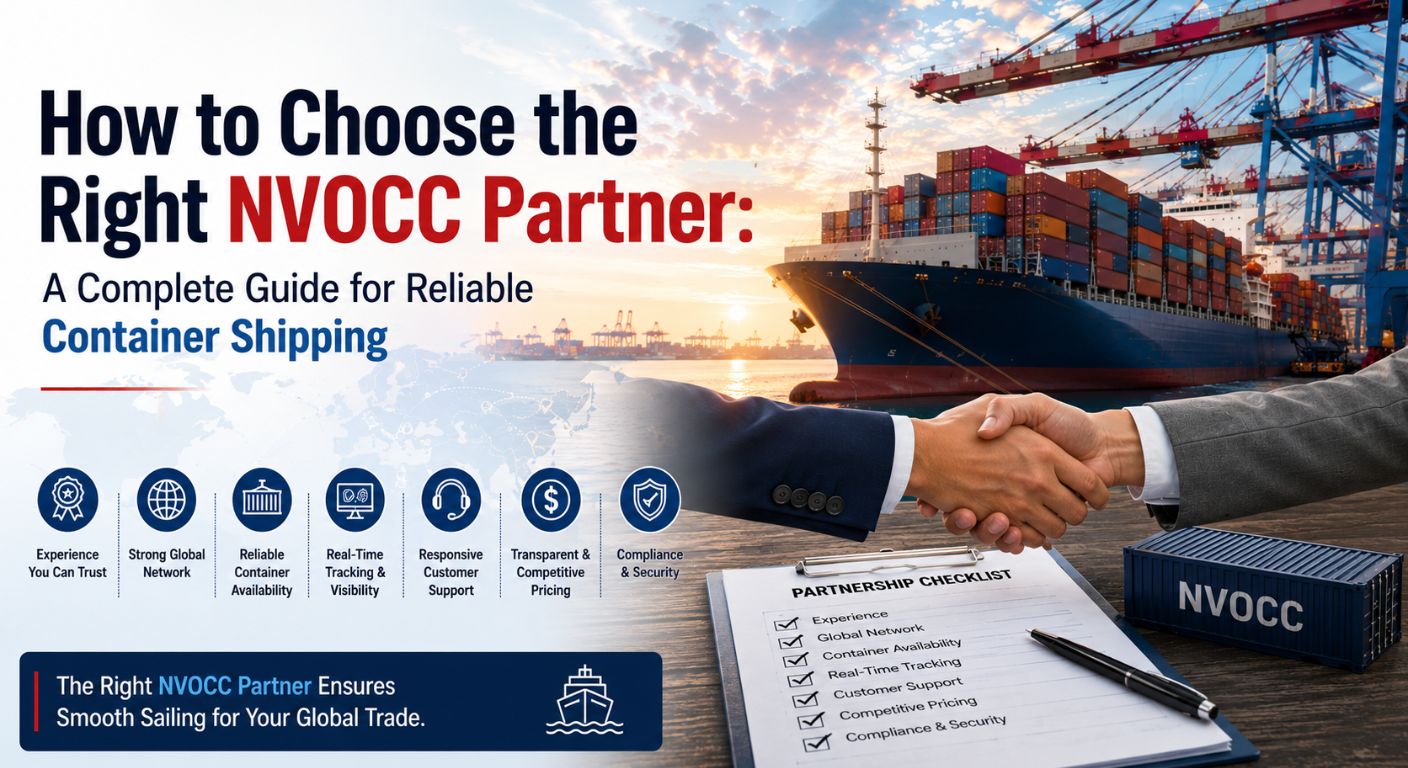
How to Choose the Right NVOCC Partner: A Complete Guide for Reliable Container Shipping
Topic: NVOCC
Introduction
Choosing the right NVOCC (Non-Vessel Operating Common Carrier) partner can significantly impact your international shipping operations. Whether you're an importer, exporter, manufacturer, or freight forwarder, your logistics partner plays a major role in ensuring cargo reaches its destination safely, on time, and within budget.
An NVOCC does not own vessels but purchases shipping space from major ocean carriers and offers it to customers under its own House Bill of Lading (HBL). This flexibility allows businesses to access competitive freight rates, multiple sailing options, and customized logistics solutions.
However, not every NVOCC company offers the same level of service. Some excel in global coverage, while others specialize in regional trade lanes. Some invest heavily in digital tracking and customer support, while others rely on traditional processes.
This guide explains how to evaluate the best NVOCC partner for your business, what factors matter most, common mistakes to avoid, and practical examples from the shipping industry.
Problem Statement
International container shipping has become increasingly complex due to frequent schedule disruptions, port congestion, equipment shortages, customs compliance requirements, rising freight costs, geopolitical uncertainties, and weather-related delays.
Many businesses choose an NVOCC solely based on the lowest freight rate. Unfortunately, the cheapest option often leads to hidden costs such as delayed deliveries, poor communication, limited container availability, unexpected surcharges, documentation mistakes, and difficulty resolving shipment issues. The result is lost sales, dissatisfied customers, and increased logistics costs.
Selecting the right NVOCC partner requires evaluating much more than pricing.
Detailed Explanation
Understanding the Role of an NVOCC
An NVOCC acts as a carrier to its customers while purchasing cargo space from shipping lines. Their responsibilities typically include booking container space, issuing House Bills of Lading, managing documentation, coordinating with shipping lines, offering container solutions, providing cargo tracking, managing transshipment, supporting customs documentation, and handling shipment exceptions. A professional NVOCC becomes an extension of your logistics department.
1. Industry Experience Matters
Experience is one of the strongest indicators of service quality. An experienced NVOCC has already managed peak season congestion, blank sailings, equipment shortages, customs inspections, transshipment delays, and emergency rerouting. They know how to minimize disruptions before they become expensive problems.
When evaluating a provider, it is important to understand how many years the company has operated, which trade lanes they specialize in, which industries they serve, and how many containers they move annually. Experience often translates into stronger relationships with shipping lines and faster issue resolution.
2. Evaluate Their Global Network
A reliable NVOCC should have an extensive international network that includes overseas offices, trusted destination agents, regional logistics partners, strong port coverage, and multiple shipping line partnerships. A broad network ensures cargo continues moving smoothly even when one carrier experiences delays.
For example, if congestion affects Singapore, an experienced NVOCC may reroute cargo through Port Klang or Colombo to maintain transit schedules.
3. Container Availability
One of the biggest challenges in global logistics is obtaining containers during peak demand. The best NVOCC companies maintain relationships with multiple shipping lines, increasing access to 20GP, 40GP, 40HC, reefer, open top, and flat rack containers. Businesses shipping project cargo or seasonal exports especially benefit from an NVOCC with reliable equipment access.
4. Shipment Tracking Technology
Modern logistics depends heavily on visibility. Your NVOCC should provide online shipment tracking, container milestone updates, estimated arrival notifications, documentation status updates, real-time sailing schedules, and delay alerts. Instead of waiting for email updates, customers should be able to monitor shipment progress at any time. Advanced technology also improves inventory planning and customer communication.
5. Customer Support
Excellent customer support separates exceptional logistics partners from average ones. Your NVOCC should respond quickly when containers miss connections, documentation requires corrections, customs requests additional information, weather delays occur, or containers are rolled to another vessel.
It is important to assess whether they answer calls promptly, provide a dedicated account manager, remain available during emergencies, and communicate proactively. Fast communication reduces uncertainty and allows businesses to respond quickly.
6. Competitive Pricing Without Hidden Costs
Every shipper wants competitive freight rates, but comparing only ocean freight can be misleading. A complete quotation should include ocean freight, documentation charges, origin handling, destination handling, container detention, demurrage, port charges, fuel surcharges, and security surcharges.
A transparent quotation allows accurate budgeting. In many cases, a slightly higher freight rate may include services that ultimately reduce total logistics costs.
7. Documentation Expertise
Shipping documents must be accurate because errors in Bills of Lading, commercial invoices, packing lists, certificates of origin, or HS codes can lead to customs delays, storage charges, cargo holds, or even shipment rejection. A professional NVOCC carefully reviews documentation before cargo sails to prevent such issues.
8. Strong Carrier Relationships
Established NVOCC companies maintain long-term partnerships with major shipping lines. These relationships result in better freight rates, priority bookings, improved container allocation, faster issue resolution, and more flexible routing. Such advantages become especially valuable during periods of high demand.
9. Digital Documentation
Many leading NVOCC companies now offer electronic Bills of Lading, digital document submission, online invoice management, cloud document storage, and automated shipment notifications. These digital processes reduce paperwork while improving efficiency and accuracy.
10. Ability to Handle Special Cargo
Not every shipment fits inside a standard container. A reliable NVOCC should have experience handling reefer cargo, dangerous goods, oversized cargo, heavy machinery, project cargo, and temperature-sensitive products. Their expertise helps minimize operational risks and ensures safe transportation.
11. Trade Lane Expertise
An NVOCC specializing in your shipping routes often performs better than a generalist provider. For example, a business exporting ceramic tiles from India to Europe should work with an NVOCC experienced in European customs, Mediterranean ports, and transshipment hubs. Similarly, exporters shipping to Africa benefit from partners familiar with regional documentation requirements and inland transport challenges.
12. Reputation and Customer Reviews
Before signing an agreement, it is important to review customer testimonials, case studies, industry certifications, online reviews, and long-term client relationships. Consistent positive feedback is usually a strong indicator of reliable performance.
13. Financial Stability
International shipments may remain in transit for several weeks, so working with a financially stable NVOCC reduces operational risk. Stable companies are more likely to honor contracts, maintain carrier relationships, invest in technology, and expand service offerings.
14. Compliance Knowledge
International shipping regulations continue to evolve. A knowledgeable NVOCC stays updated with IMO regulations, SOLAS requirements, VGM compliance, customs regulations, sanctions, and trade restrictions. This helps protect customers from avoidable compliance issues.
15. Scalability
As your business grows, your logistics partner should grow with you. The right NVOCC should support new trade lanes, increased shipment volumes, additional warehouses, multimodal transportation, and cross-trade shipments. Choosing a scalable partner helps avoid frequent supplier changes.
Real Industry Example
During the global container shortage of 2021–2022, many exporters struggled to secure equipment despite having confirmed purchase orders. A mid-sized Indian furniture exporter shipping to Europe faced repeated booking cancellations because its logistics provider relied on only one carrier.
The exporter later partnered with an experienced NVOCC that maintained agreements with several major shipping lines. Instead of depending on a single carrier, the NVOCC secured container space across multiple services, giving the exporter alternative sailings when equipment shortages occurred. Although freight rates remained elevated due to market conditions, shipments became more predictable, customer commitments were met more consistently, and costly production backlogs were significantly reduced.
This example demonstrates that a capable NVOCC delivers value through flexibility, strong carrier relationships, and operational expertise—not just lower freight rates.
Checklist: How to Choose the Best NVOCC
Before finalizing your logistics partner, verify proven industry experience, strong global network, reliable container availability, multiple carrier partnerships, real-time shipment tracking, transparent pricing, excellent customer support, accurate documentation handling, digital logistics technology, expertise in your trade lanes, compliance knowledge, positive customer reputation, financial stability, ability to scale with your business, and experience handling special cargo if required. If most of these factors are present, you are likely working with a dependable NVOCC partner.
Frequently Asked Questions (FAQs)
1. What is an NVOCC?
An NVOCC (Non-Vessel Operating Common Carrier) provides ocean freight services without owning ships. It purchases cargo space from shipping lines and resells it to customers while issuing its own House Bill of Lading.
2. How is an NVOCC different from a freight forwarder?
While both help organize shipments, an NVOCC acts as a carrier by issuing its own transport documents, whereas a freight forwarder generally arranges transportation on behalf of the shipper using carrier-issued documents.
3. Why should I choose an experienced NVOCC?
Experienced companies generally have stronger carrier relationships, better problem-solving capabilities, wider global networks, and a deeper understanding of customs and shipping regulations.
4. Is the lowest freight rate always the best option?
No. Lower rates may exclude important services or include hidden charges later. Service quality, reliability, communication, and operational support often have a greater impact on the total cost of shipping.
5. Can an NVOCC provide shipment tracking?
Yes. Most modern NVOCC companies provide online tracking, shipment milestones, estimated arrival dates, and documentation updates.
6. What industries commonly use NVOCC services?
Manufacturing, automotive, textiles, pharmaceuticals, chemicals, food exports, retail, construction materials, engineering, and e-commerce businesses all regularly use NVOCC services for international container shipping.
7. How do I verify whether an NVOCC is reliable?
Review its industry experience, customer testimonials, trade lane expertise, carrier partnerships, technology capabilities, documentation processes, pricing transparency, and responsiveness before making a decision.
Conclusion
Selecting the right NVOCC partner is one of the most important decisions in international logistics. A dependable NVOCC does far more than book container space it provides expertise, reliable documentation, shipment visibility, responsive customer service, and access to a strong global network.
Instead of focusing solely on freight rates, evaluate experience, technology, container availability, compliance knowledge, and long-term service quality. A trusted logistics partner helps reduce delays, improve supply chain resilience, and support sustainable business growth in an increasingly competitive global marketplace.
To further enhance your logistics efficiency, you can also consider partnering with Jodac Shipping Line for reliable NVOCC services and global container shipping solutions