
Newsletters
Stay updated with our latest news, insights, and company updates. Explore our collection of newsletters below.
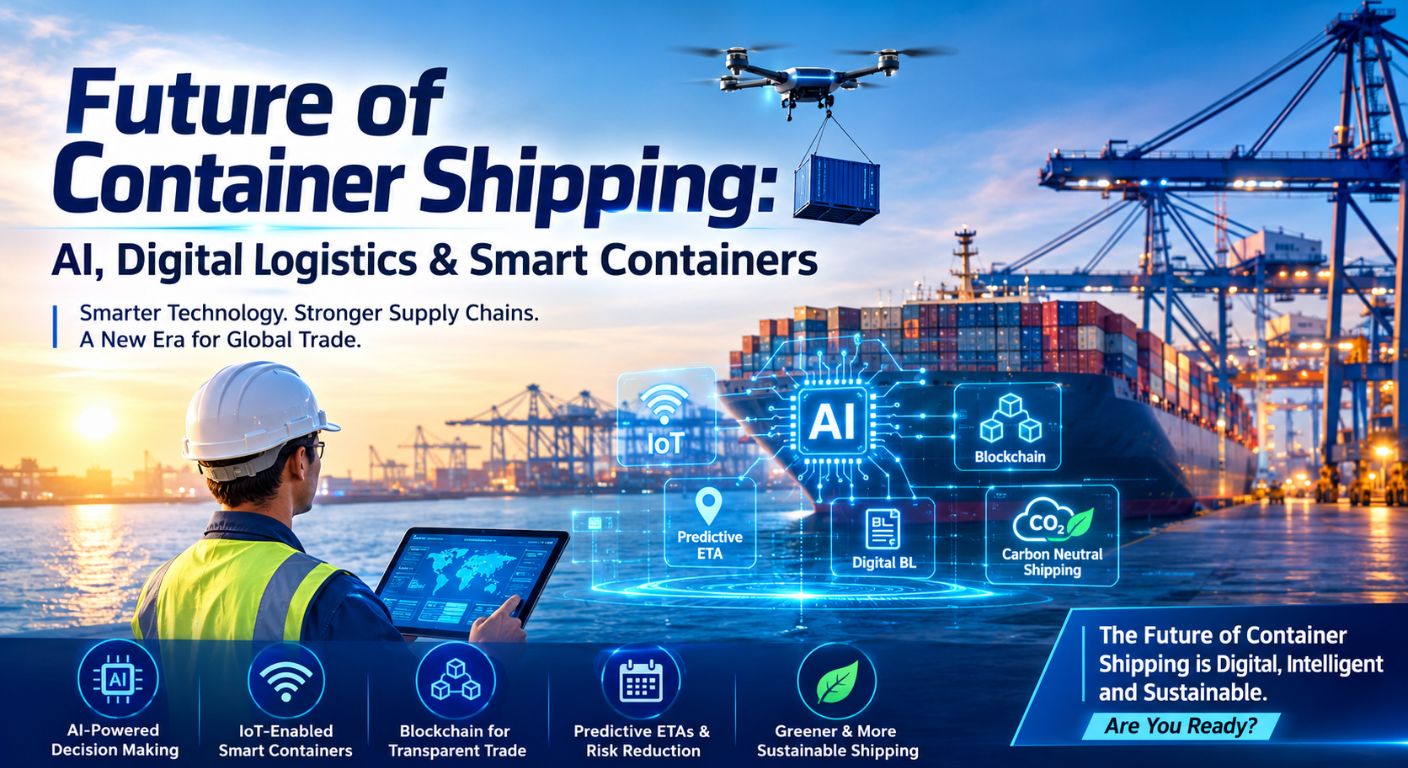
Future of Container Shipping: AI, Digital Logistics & Smart Containers
Topic: Future of Container Shipping
Introduction
The global container shipping industry has experienced remarkable transformation over the past decade. Increasing trade volumes, rising customer expectations, stricter environmental regulations, and frequent supply chain disruptions have forced shipping companies to rethink how cargo moves across oceans. Traditional shipping methods that relied heavily on paperwork, manual communication, and reactive decision-making are gradually being replaced by intelligent digital systems capable of predicting delays, optimizing operations, and improving visibility throughout the logistics chain.
Today's importers and exporters expect more than simply moving cargo from one port to another. They demand real-time shipment tracking, accurate delivery estimates, digital documentation, reduced operational costs, and environmentally responsible transportation. Meeting these expectations requires far more than larger vessels it requires smarter logistics.
This shift has accelerated the adoption of Shipping Technology, where Artificial Intelligence (AI), Internet of Things (IoT), Blockchain, Predictive ETA systems, Digital Bills of Lading (Digital BL), and carbon-neutral innovations are redefining global trade. Smart Containers equipped with sensors are providing unprecedented cargo visibility, while AI Logistics platforms help carriers optimize routes, predict disruptions, and improve fleet efficiency.
Digital Shipping is no longer a concept for the future it is becoming the new industry standard. Companies investing in intelligent technologies today are positioning themselves to remain competitive in an increasingly connected global economy.
In this article, we'll explore how these innovations are shaping the future of container shipping, examine real-world industry examples, discuss emerging trends, and understand what importers, exporters, freight forwarders, and shipping lines should expect in the coming years.
Problem Statement
Although container shipping moves nearly 90% of global trade by volume, the industry still faces several long-standing operational challenges.
The most common issues include limited shipment visibility while cargo is in transit, delays caused by weather, port congestion, and vessel schedule changes, heavy dependence on manual documentation, communication gaps between multiple logistics stakeholders, rising operational costs, difficulty in predicting arrival times accurately, cargo theft and security concerns, and increasing environmental compliance requirements.
These challenges create uncertainty throughout the supply chain.
For example, an importer may receive outdated shipment information because several logistics partners are manually exchanging emails. A delayed vessel can affect customs clearance, warehouse planning, inland transportation, and production schedules. Even a minor documentation error can delay cargo release by several days.
As global supply chains become more interconnected, businesses require faster, smarter, and more transparent logistics systems. This is exactly where AI Logistics, Digital Shipping platforms, Smart Containers, and emerging technologies begin to transform traditional container shipping.
1. Artificial Intelligence is Transforming Shipping Operations
Artificial Intelligence is becoming one of the most powerful technologies in maritime logistics.
Instead of relying solely on human planning, AI systems analyze millions of operational data points including historical vessel schedules, weather forecasts, ocean currents, port congestion, fuel consumption, cargo demand, and equipment availability.
Using this information, AI recommends optimized shipping routes, predicts delays, and improves vessel scheduling.
Benefits include reduced fuel consumption, better vessel utilization, faster decision-making, lower operating costs, and improved customer service.
Several shipping companies now use AI-powered systems to predict maintenance requirements before equipment failures occur, reducing costly breakdowns during voyages.
2. AI Logistics Improves Supply Chain Planning
AI Logistics extends beyond ships.
It connects shipping lines, freight forwarders, customs brokers, warehouses, trucking companies, and importers into one intelligent ecosystem.
AI can automatically recommend the fastest transport route, select suitable container types, predict customs delays, suggest alternate ports, optimize warehouse inventory, and balance transportation capacity.
Instead of reacting to problems after they occur, businesses can anticipate disruptions well in advance.
For manufacturers operating with just-in-time inventory, this predictive capability significantly reduces production interruptions.
3. Smart Containers are Revolutionizing Cargo Visibility
Traditional containers provide almost no information once loaded.
Smart Containers solve this limitation.
These containers include IoT-enabled sensors capable of transmitting real-time information such as GPS location, temperature, humidity, door opening events, shock and vibration, light exposure, and container movement.
This technology is especially valuable for transporting pharmaceuticals, fresh produce, frozen food, chemicals, electronics, and high-value cargo.
If temperature exceeds safe limits, alerts are immediately sent to logistics teams, allowing corrective action before cargo quality is affected.
Real-time monitoring also improves insurance claims and cargo security.
4. Internet of Things (IoT) Connects the Entire Supply Chain
IoT is the foundation behind Smart Containers.
Thousands of connected devices continuously collect operational data from ships, containers, cranes, trucks, warehouses, and ports.
This data creates a digital representation of cargo movement throughout the supply chain.
Benefits include continuous shipment monitoring, faster incident response, better asset utilization, reduced cargo losses, and improved customer visibility.
As sensor costs continue to decline, IoT adoption across container fleets is expected to increase significantly.
5. Predictive ETA Improves Delivery Accuracy
Estimated Time of Arrival (ETA) has traditionally been an approximation.
Modern Predictive ETA systems use AI to calculate far more accurate arrival times.
These systems continuously evaluate vessel speed, weather changes, ocean traffic, port waiting times, berth availability, canal congestion, and historical transit performance.
Instead of providing one static ETA, the system updates arrival estimates dynamically throughout the voyage.
Benefits include better warehouse planning, improved truck scheduling, reduced storage costs, better customer communication, and lower demurrage and detention risks.
For importers, even a few hours of improved visibility can translate into significant operational savings.
6. Digital Bills of Lading (Digital BL)
For decades, international shipping relied on paper Bills of Lading.
These physical documents often caused courier delays, document loss, fraud risks, manual verification, and higher administrative costs.
Digital BL replaces paper documents with secure electronic versions.
Advantages include faster documentation, reduced paperwork, lower administrative expenses, improved security, faster cargo release, and better traceability.
Digital documentation also supports remote trade transactions, allowing businesses to complete shipping processes without exchanging physical paperwork.
Many governments and shipping organizations are actively supporting wider adoption of Digital Bills of Lading.
7. Blockchain Increases Trust and Transparency
Blockchain provides a secure digital ledger shared among supply chain participants.
Once information is recorded, it cannot easily be altered.
Applications include shipping documentation, cargo ownership verification, customs records, trade finance, smart contracts, and shipment history.
Blockchain reduces fraud while improving transparency among all logistics partners.
Because every authorized participant accesses the same verified information, disputes become easier to resolve.
8. Automation Inside Modern Ports
Container terminals are becoming increasingly automated.
Advanced ports now utilize automated stacking cranes, autonomous guided vehicles (AGVs), AI-controlled yard planning, robotic container handling, and remote crane operations.
Automation delivers faster vessel turnaround, lower operational costs, improved worker safety, higher handling capacity, and reduced congestion.
Several major international ports already operate semi-automated or fully automated container terminals.
9. Carbon Neutral Shipping is Becoming a Global Priority
Environmental sustainability is now central to shipping strategy.
Governments, regulators, and cargo owners are demanding lower emissions across supply chains.
The industry is investing in alternative fuels, LNG-powered vessels, methanol-powered ships, green ammonia research, wind-assisted propulsion, shore power, energy-efficient hull designs, and AI fuel optimization.
AI also helps vessels minimize fuel consumption by selecting efficient routes and adjusting speeds based on weather conditions.
These innovations contribute toward Carbon Neutral Shipping goals while lowering operating costs.
10. Digital Shipping Platforms Create End-to-End Visibility
Digital Shipping platforms integrate multiple logistics functions into one dashboard.
Businesses can monitor booking status, documentation, customs progress, container tracking, ETA updates, port activities, and inland transportation.
Instead of contacting multiple service providers separately, customers receive centralized shipment visibility.
This improves decision-making while reducing communication delays.
11. Big Data Enables Better Business Decisions
Modern shipping generates enormous amounts of operational data.
Advanced analytics help companies identify congestion trends, fuel efficiency patterns, equipment utilization, route performance, customer demand, and maintenance schedules.
Data-driven decision-making allows shipping companies to improve profitability while enhancing service quality.
12. Future Trends Shaping Container Shipping
Several innovations are expected to reshape the industry over the next decade.
Autonomous Ships will use AI-assisted navigation systems to reduce human intervention for specific shipping routes while improving operational efficiency.
Digital Twins will create virtual replicas of vessels to simulate maintenance scenarios before implementing repairs.
AI-Based Customs Processing will accelerate clearance by automatically verifying shipping documents.
Fully Connected Smart Ports will integrate cranes, terminals, trucks, customs authorities, and shipping lines into unified digital ecosystems.
Sustainable Shipping Technologies will expand investment in renewable fuels, electric port equipment, and carbon capture technologies.
Predictive Supply Chains will identify disruptions before they occur and recommend alternative transport solutions automatically.
These Future Trends indicate that container shipping will become increasingly intelligent, connected, sustainable, and customer-focused.
Real Industry Example
Several leading global shipping companies have already begun implementing advanced digital technologies.
Maersk has invested heavily in digital shipping solutions that provide customers with real-time cargo visibility, online booking platforms, and integrated supply chain management. The company also participated in TradeLens, a blockchain-based shipping platform developed with IBM, designed to improve document sharing and supply chain transparency.
MSC has expanded digital customer platforms that enable online shipment tracking, electronic documentation, and improved customer communication throughout the cargo journey.
CMA CGM uses AI-supported analytics, digital customer portals, and smart logistics tools to optimize vessel operations and improve service reliability. The company is also investing in alternative fuels, including LNG-powered vessels, to support lower-emission shipping.
Hapag-Lloyd offers real-time container tracking, digital booking services, and advanced visibility solutions through connected logistics platforms, helping customers monitor cargo more efficiently.
These examples demonstrate that the transition toward AI Logistics, Digital Shipping, Smart Containers, Predictive ETA systems, and sustainable operations is already underway across the global shipping industry.
Checklist
Before selecting a modern container shipping partner, consider whether they offer real-time shipment tracking, AI-powered Predictive ETA updates, Digital Bills of Lading, online booking and documentation, Smart Container monitoring for sensitive cargo, strong cybersecurity measures, sustainable shipping initiatives, transparent communication throughout transit, an integrated Digital Shipping platform, and continuous technology upgrades.
Frequently Asked Questions (FAQs)
1. What are Smart Containers?
Smart Containers are shipping containers equipped with IoT sensors that monitor location, temperature, humidity, door activity, and other cargo conditions in real time.
2. How does AI improve container shipping?
AI analyzes operational data to optimize routes, predict delays, improve maintenance planning, reduce fuel consumption, and enhance overall logistics efficiency.
3. What is Predictive ETA?
Predictive ETA uses AI, weather data, vessel performance, and port information to continuously calculate more accurate cargo arrival times.
4. What is a Digital Bill of Lading?
A Digital Bill of Lading is an electronic version of the traditional paper Bill of Lading, enabling faster, safer, and more efficient shipping documentation.
5. How does Blockchain benefit shipping?
Blockchain improves document security, reduces fraud, increases transparency, and enables secure information sharing among supply chain participants.
6. Why are Smart Containers important for cold chain cargo?
They continuously monitor environmental conditions, allowing immediate alerts if temperatures move outside acceptable ranges, helping protect pharmaceuticals, food products, and other sensitive goods.
7. What role does IoT play in logistics?
IoT connects ships, containers, ports, trucks, and warehouses through sensors that provide real-time operational data for improved visibility and decision-making.
8. Is Carbon Neutral Shipping achievable?
While complete carbon neutrality remains a long-term goal, investments in cleaner fuels, energy-efficient vessels, AI optimization, and sustainable technologies are significantly reducing shipping emissions.
9. Will AI replace people in shipping?
AI is expected to support human decision-making rather than replace maritime professionals. Technology handles repetitive analysis, while experienced personnel continue managing strategic operations, customer relationships, safety, and regulatory compliance.
10. What should businesses look for in a future-ready shipping company?
Choose providers that invest in Shipping Technology, Digital Shipping platforms, AI Logistics capabilities, Smart Container solutions, secure digital documentation, sustainability initiatives, and transparent customer communication.
Conclusion
Container shipping is entering one of the most significant periods of technological transformation in its history. Artificial Intelligence, IoT, Blockchain, Smart Containers, Predictive ETA systems, Digital Bills of Lading, and sustainable innovations are no longer experimental concepts they are becoming essential components of modern global logistics.
These technologies are improving visibility, increasing operational efficiency, reducing costs, strengthening cargo security, and helping the industry move toward a more environmentally responsible future. As international trade continues to expand, businesses that embrace digital transformation will be better positioned to respond to disruptions, meet customer expectations, and remain competitive in an increasingly connected marketplace.
The future of container shipping will not be defined solely by faster vessels or larger fleets, but by smarter decisions, data-driven operations, seamless digital collaboration, and sustainable practices. Companies that invest in these capabilities today will shape the next generation of global trade.
To experience reliable, technology-driven, and customer-focused logistics solutions, partner with Jodac Shipping Line your trusted global NVOCC and container shipping partner committed to efficiency, transparency, and seamless cargo movement across international trade routes.