
Newsletters
Stay updated with our latest news, insights, and company updates. Explore our collection of newsletters below.
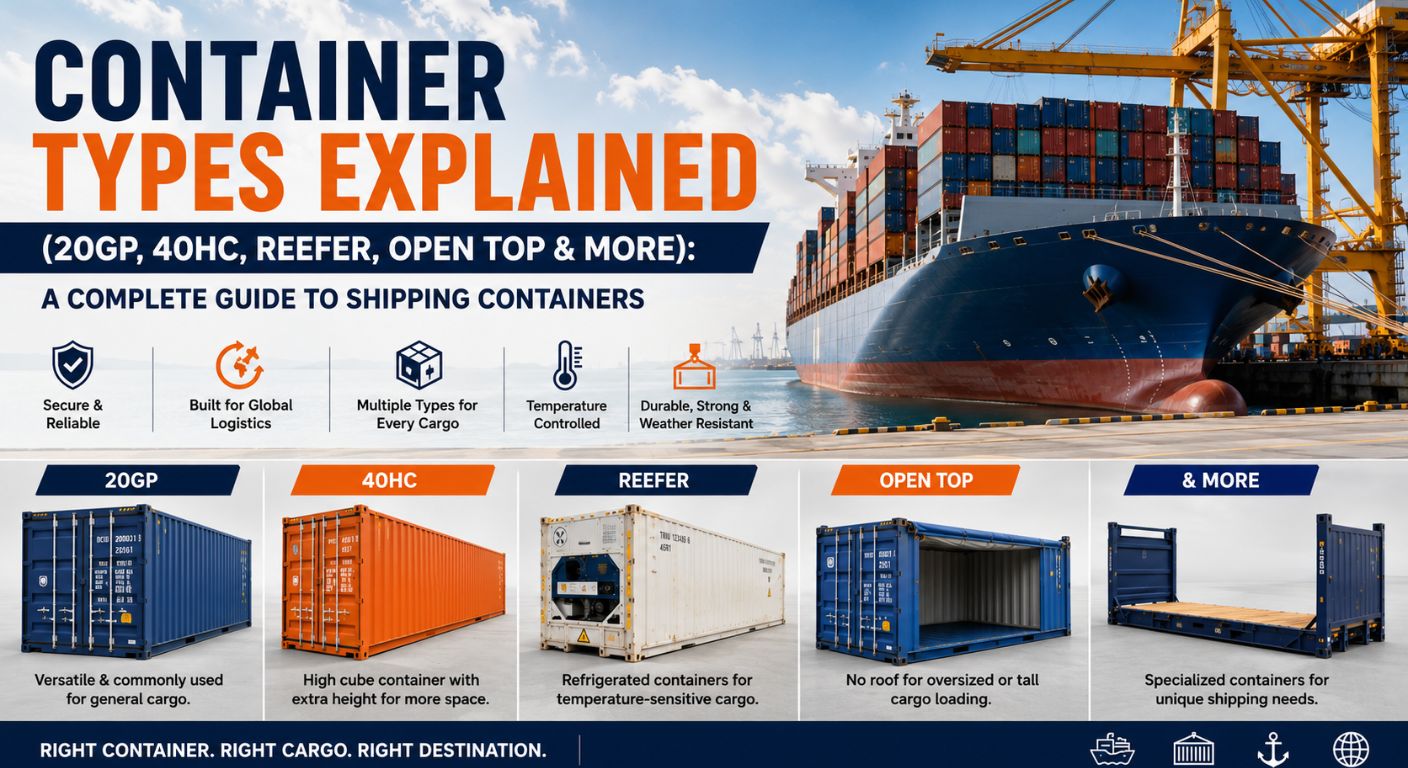
Container Types Explained (20GP, 40HC, Reefer, Open Top & More): A Complete Guide to Shipping Containers
Topic: Container Types
Introduction
In global trade, every product that moves across international borders—whether electronics, machinery, automobiles, textiles, pharmaceuticals, or food products—depends on one essential element: the shipping container. These standardized steel units have transformed international logistics by making cargo transportation safer, faster, and more cost-efficient.
Today, millions of containers move daily through ports, rail networks, and highways worldwide. However, not all containers serve the same purpose. Choosing the wrong container type can lead to cargo damage, increased shipping costs, delays, and compliance issues.
Understanding different container types such as 20GP, 40HC, Flat Rack, Reefer, and ISO containers is essential for exporters, importers, freight forwarders, and logistics professionals to ensure smooth and efficient cargo movement.
This guide provides a complete SEO-optimized overview of the most commonly used shipping containers, including their sizes, weight capacities, applications, and real-world industry usage.
Why Choosing the Right Container Type Matters
Many businesses assume that all shipping containers are the same, but in reality, each container is designed for specific cargo requirements. While standard dry containers handle general goods, specialized cargo often requires purpose-built solutions based on size, weight, and environmental conditions.
Selecting the wrong container can result in cargo damage during transit, higher freight and handling costs, inefficient space utilization, loading and unloading difficulties, customs delays, safety risks, and additional port charges. For example, shipping frozen seafood in a standard dry container instead of a Reefer container can lead to complete spoilage, while oversized machinery may not physically fit into a standard container.
Proper container selection ensures cost efficiency, cargo safety, and smooth supply chain operations.
What is an ISO Container?
An ISO container is a standardized shipping container designed according to specifications set by the International Organization for Standardization (ISO). These standards ensure uniform dimensions, structural strength, corner fittings, and handling compatibility across ships, trucks, and trains worldwide.
Because of this standardization, ISO containers enable seamless multimodal transportation without the need to unload and repack cargo at every transfer point, making global logistics more efficient and reliable.
20GP (20-Foot General Purpose Container)
The 20GP container is one of the most widely used shipping containers in international trade. It is especially suitable for heavy and dense cargo due to its strong payload capacity and compact size.
A 20GP container typically has an external length of 20 feet, with an internal length of approximately 5.9 meters, a width of around 2.35 meters, and a height of about 2.39 meters. It can carry a maximum gross weight of around 30,480 kg, depending on manufacturer specifications.
This container type is commonly used for transporting steel products, machinery, industrial equipment, chemicals, ceramic goods, automotive parts, and paper rolls. Industries such as manufacturing, automotive, engineering, mining, and heavy industries frequently rely on 20GP containers for export and import operations.
40GP (40-Foot General Purpose Container)
The 40GP container offers nearly double the internal volume of a 20GP container while maintaining a similar width. It is ideal for transporting large quantities of lightweight cargo where volume is more important than weight.
With a length of 40 feet and significantly higher cubic capacity, the 40GP container is widely used for furniture, consumer goods, electronics, retail merchandise, and packaging materials. It is especially popular in retail, FMCG, wholesale distribution, and e-commerce logistics due to its ability to carry bulk shipments efficiently.
40HC (40-Foot High Cube Container)
The 40HC container is similar to the 40GP but offers an additional foot of internal height, making it ideal for bulky or oversized cargo that requires extra vertical space.
With a height of 9 feet 6 inches, the 40HC provides greater storage capacity while maintaining similar weight limits to a standard 40GP container. It is commonly used for furniture, mattresses, textiles, plastic goods, clothing, and home décor products.
Industries such as furniture manufacturing, apparel export, retail supply chains, and e-commerce logistics prefer 40HC containers for maximizing cargo volume efficiency.
Reefer Container
A Reefer container is a temperature-controlled shipping container equipped with a refrigeration system that maintains precise internal temperatures throughout transit. These containers are essential for transporting perishable and temperature-sensitive goods.
Reefer containers are available in both 20-foot and 40-foot sizes and can typically maintain temperatures ranging from approximately -30°C to +30°C, depending on the system.
They are widely used for frozen seafood, meat, fruits, vegetables, dairy products, pharmaceuticals, vaccines, and flowers. Industries such as agriculture, food processing, pharmaceuticals, and healthcare logistics depend heavily on Reefer containers to ensure product quality and safety during international transport.
Flat Rack Container
A Flat Rack container is designed for oversized, heavy, or irregularly shaped cargo that cannot fit into standard enclosed containers. It features open sides and either fixed or collapsible end walls, allowing loading from the top or sides.
Flat Rack containers are commonly used for industrial generators, construction equipment, wind turbine components, large pipes, steel coils, and heavy machinery. They are widely used in oil and gas projects, renewable energy sectors, heavy engineering, infrastructure development, and project cargo logistics.
Open Top Container
An Open Top container is designed with a removable roof covered by a tarpaulin, allowing cargo to be loaded from the top using cranes. This makes it ideal for tall or heavy cargo that cannot be easily loaded through standard doors.
It is commonly used for marble blocks, boilers, heavy machinery, timber, industrial equipment, and glass sheets. Industries such as construction, mining, engineering, and manufacturing frequently use Open Top containers for specialized cargo handling.
Tank Container
Tank containers are specialized units designed for the safe transportation of liquids, including hazardous and non-hazardous materials. These containers ensure secure handling of liquid cargo across international supply chains.
They are used for chemicals, food-grade liquids, edible oils, milk, fuel, hazardous liquids, and alcohol. Industries such as chemical manufacturing, petroleum, food processing, and pharmaceuticals rely on tank containers for safe liquid transportation.
Ventilated Container
Ventilated containers are designed to allow continuous airflow, making them suitable for agricultural products that require natural ventilation during transit.
They are commonly used for coffee beans, cocoa, garlic, onions, and seeds. These containers are widely used in agricultural export supply chains to maintain product freshness and quality.
Open Side Container
Open Side containers feature large side-opening doors that allow easy access for loading and unloading long or irregular cargo. This design improves operational efficiency in handling oversized goods.
They are used for machinery, exhibition equipment, long steel products, and retail fixtures. Industries involved in manufacturing, exhibitions, and industrial logistics benefit from their flexible loading capabilities.
Double Door Container
Double Door containers are designed with doors at both ends, allowing easy access and faster cargo handling. This design improves loading efficiency and simplifies warehouse operations.
They are commonly used for retail distribution, warehousing, and consumer goods logistics, especially in high-volume supply chain operations.
Container Size Comparison Overview
The 20GP container typically offers around 33 cubic meters of volume and is best suited for heavy cargo. The 40GP provides approximately 67 cubic meters and is ideal for general cargo. The 40HC offers around 76 cubic meters, making it suitable for bulky shipments. Reefer containers vary in capacity depending on temperature requirements, while Flat Rack and Open Top containers are designed for oversized and project cargo.
Understanding Container Weight
Container selection also depends on weight considerations, which include tare weight, payload, and gross weight. Tare weight refers to the empty container weight, payload is the maximum cargo weight it can carry, and gross weight is the combined total of container and cargo.
Since shipping lines and transport authorities impose different weight restrictions, proper cargo planning is essential before booking to avoid penalties and delays.
How to Choose the Right Shipping Container
Selecting the right container depends on several factors such as cargo dimensions, weight, temperature sensitivity, loading method, transportation mode, and destination regulations. Businesses must evaluate whether cargo is oversized, requires refrigeration, or needs crane loading before finalizing container selection.
Proper assessment ensures cost efficiency, cargo safety, and compliance with international shipping standards.
Real-World Industry Examples
In engineering exports, companies often adjust container selection based on weight distribution and transport regulations. For example, industrial machinery initially planned for a 40HC container may be shifted to multiple 20GP containers to comply with road transport limits and improve safety.
In seafood exports, Reefer containers are used to maintain freezing temperatures throughout the journey, ensuring product freshness and compliance with international food safety standards.
In renewable energy projects, Flat Rack containers are used to transport oversized wind turbine components that cannot fit into standard containers, enabling safe and efficient global delivery.
Conclusion
Shipping containers are not just steel boxes but highly specialized logistics tools designed to handle different types of cargo efficiently. From 20GP and 40HC containers for general cargo to Reefer, Flat Rack, and Open Top containers for specialized shipments, each container type plays a critical role in global trade.
Understanding container types, sizes, and applications helps businesses reduce costs, improve cargo safety, and streamline supply chain operations. Choosing the right container from the beginning ensures smoother logistics, fewer delays, and better overall shipping performance.
For reliable and efficient container shipping solutions, Jodac Shipping Line offers end-to-end support for all your freight requirements. Whether you need assistance in selecting the right container, booking space, or managing international shipments, our team ensures smooth and cost-effective logistics from origin to destination. Partner with Jodac Shipping Line to simplify your global trade operations and move your cargo with confidence.