
Newsletters
Stay updated with our latest news, insights, and company updates. Explore our collection of newsletters below.
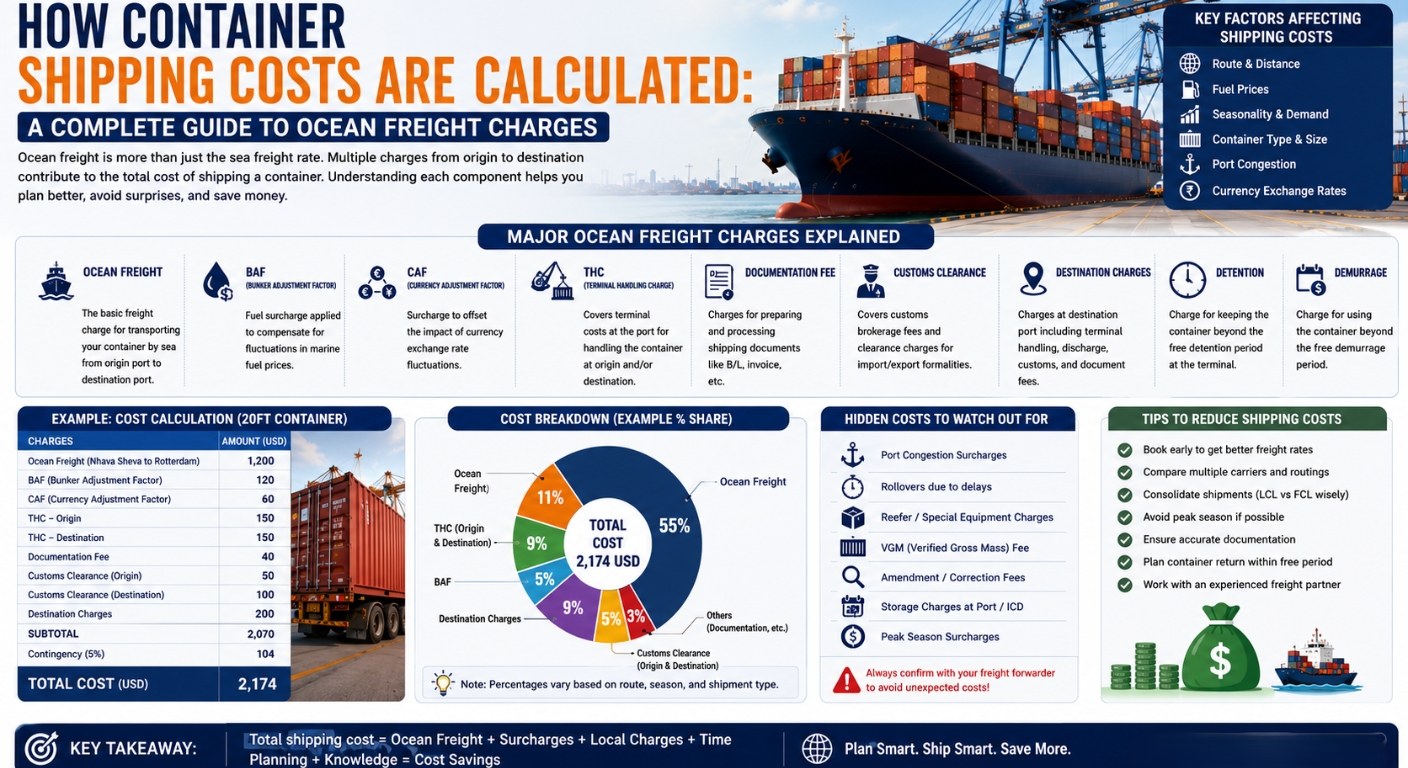
How Container Shipping Costs Are Calculated: A Complete Guide to Ocean Freight Charges
Topic: Container shippng cost
Introduction
Understanding how container shipping costs are calculated is essential for any business involved in international trade. Whether you are importing raw materials or exporting finished goods, ocean freight pricing directly impacts your total landed cost and profit margins. However, most importers and exporters receive freight quotations filled with multiple technical terms such as Ocean Freight, BAF, CAF, THC, documentation charges, customs fees, destination charges, demurrage, and detention without fully understanding what they actually mean.
This lack of clarity often leads to unexpected expenses, inaccurate budgeting, and reduced profitability. The reality is that container shipping is not just about paying for transportation from one port to another. It is a complex process involving shipping lines, port authorities, customs departments, freight forwarders, and terminal operators, all of whom contribute to the final cost.
In this detailed guide, you will learn how container shipping costs are calculated, what each charge means, why freight rates fluctuate, and how businesses can reduce unnecessary logistics expenses while improving supply chain efficiency.
Why Understanding Container Shipping Costs Is Important
Many businesses make the mistake of comparing freight quotations only based on the ocean freight rate. While this may seem like the most important number, it rarely reflects the true cost of shipping. A lower ocean freight rate can often result in higher overall expenses once additional charges are added at origin and destination.
These additional costs may include port handling charges, documentation fees, customs clearance expenses, destination terminal charges, equipment imbalance surcharges, currency adjustments, storage penalties, demurrage, and detention. Without understanding these components, businesses struggle to calculate the actual landed cost of their goods.
To avoid financial surprises, it is important to understand the complete structure of container shipping costs before confirming any shipment.
Complete Structure of Container Shipping Costs
Container shipping costs are generally divided into three main categories: origin charges, ocean freight charges, and destination charges. Each of these categories includes multiple sub-components that together form the total shipping cost.
Ocean freight is the base transportation cost charged for moving a container from the port of origin to the destination port. This is usually the largest single component of the total shipping cost, but it is not the only one.
The final cost of shipping is influenced by several factors including cargo type, container size, trade route, fuel prices, seasonal demand, and global market conditions. Because of this, freight rates are highly dynamic and can change frequently.
Ocean Freight Cost and What Affects It
Ocean freight is the core charge in container shipping and represents the cost of physically transporting goods across international waters. However, this cost is not fixed and depends on several important factors.
The shipping route plays a major role in determining freight rates. Longer distances and less frequently serviced trade lanes generally result in higher costs. Container size also affects pricing, with 20-foot, 40-foot, and 40-foot high cube containers each having different rate structures. While larger containers cost more in absolute terms, they often provide better value per cubic meter.
Cargo type is another important factor. General cargo is usually cheaper to ship compared to hazardous materials, refrigerated goods, or oversized equipment, which require special handling and equipment. Seasonal demand also significantly impacts pricing. During peak periods such as Christmas, Chinese New Year, and major export seasons, freight rates tend to increase due to higher demand and limited vessel space.
Port congestion and global trade imbalances can also influence ocean freight costs. Busy ports such as Singapore, Rotterdam, Los Angeles, and Long Beach often experience delays and higher operational costs, which are reflected in freight pricing.
BAF and CAF in Container Shipping
In addition to base ocean freight, shipping lines apply several surcharges to account for external cost fluctuations. Two of the most common are the Bunker Adjustment Factor and the Currency Adjustment Factor.
The Bunker Adjustment Factor, commonly known as BAF, is a fuel surcharge applied to compensate for changes in marine fuel prices. Since fuel costs are highly volatile and influenced by global oil markets and geopolitical events, shipping lines adjust BAF periodically instead of changing base freight rates frequently. When fuel prices rise, BAF increases accordingly, directly impacting total shipping costs.
The Currency Adjustment Factor, or CAF, is used to manage fluctuations in exchange rates. Since international shipping involves multiple currencies, changes in currency values can affect operational costs. CAF helps shipping lines stabilize revenue by adjusting for these variations, usually on a monthly basis.
Terminal Handling Charges and Documentation Costs
Terminal Handling Charges, commonly referred to as THC, are applied for handling containers at both origin and destination ports. These charges cover activities such as container lifting, crane operations, yard movement, stacking, and general terminal labor. Many importers mistakenly assume that THC is included in ocean freight, but it is usually billed separately.
Documentation charges are another essential component of shipping costs. Every international shipment requires proper documentation, including the Bill of Lading, shipping instructions, export and import filings, and delivery orders. These administrative processes ensure legal compliance and smooth cargo movement across borders.
Customs Clearance and Destination Charges
Customs clearance is a mandatory process for all international shipments. It involves verifying cargo details, calculating duties and taxes, and ensuring compliance with import and export regulations. Customs clearance charges typically include broker fees, electronic filing costs, inspection coordination, and compliance documentation.
It is important to note that customs duties and taxes are separate from clearance service fees and are determined by government regulations based on product classification and value.
Destination charges are applied once the cargo arrives at the destination port. These may include destination THC, delivery order fees, port security charges, local handling costs, and infrastructure fees. Many importers overlook these charges when reviewing freight quotations, which can lead to unexpected expenses upon arrival.
Demurrage and Detention Charges Explained
Demurrage and detention are among the most commonly misunderstood shipping charges, yet they can significantly increase total logistics costs if not managed properly.
Demurrage is charged when a container remains inside the port or terminal beyond the allowed free storage period. This usually happens due to customs delays, missing documentation, or clearance issues. These charges are calculated on a daily basis and can accumulate quickly.
Detention, on the other hand, is charged when a container is kept outside the port beyond the permitted free time before being returned to the shipping line. For example, if a container is allowed seven free days and is returned after ten days, detention charges will apply for the additional days.
Both charges are avoidable with proper planning and efficient supply chain management.
Hidden Costs in Container Shipping
In addition to standard freight components, several hidden costs can impact the total shipping expense. These include port congestion surcharges, peak season surcharges, low sulfur fuel surcharges, equipment imbalance fees, inspection charges, storage costs, and container cleaning or fumigation fees.
These charges are often not clearly highlighted in initial quotations but can significantly affect the final landed cost if not anticipated in advance.
Real-World Example of Shipping Cost Impact
Consider an Indian exporter shipping engineering goods from Mundra Port to Hamburg in a 40-foot container. The initial freight quotation includes ocean freight, origin THC, BAF, documentation charges, and export customs clearance. However, once the shipment arrives at the destination, additional costs such as destination THC, delivery order charges, import customs clearance, import duties, and local transportation are applied.
If customs inspection delays clearance by several days, demurrage charges begin to accumulate. If the container is not returned within the free period, detention charges are also applied. As a result, the final landed cost becomes significantly higher than the original quotation, highlighting the importance of understanding all cost components in advance.
How to Reduce Container Shipping Costs
Businesses can reduce shipping costs by focusing on proper planning, accurate documentation, and efficient logistics management. Comparing complete freight quotations instead of only ocean freight rates is essential. Planning shipments in advance helps avoid peak season surcharges and space shortages.
Ensuring accurate documentation reduces customs delays, while timely container returns help avoid detention charges. Working with experienced freight forwarders and customs brokers can also improve efficiency and reduce unnecessary expenses. Additionally, choosing the right Incoterms and consolidating shipments when possible can further optimize costs.
Conclusion
Container shipping costs are made up of multiple components beyond just ocean freight. Charges such as BAF, CAF, THC, documentation fees, customs clearance, destination charges, demurrage, and detention all contribute to the final landed cost of goods. Understanding these elements is essential for accurate budgeting, cost control, and efficient international trade operations.
Businesses that take the time to understand how container shipping costs are calculated are better positioned to negotiate freight rates, avoid hidden charges, and improve overall supply chain performance. With proper planning and the right logistics partners, companies can significantly reduce shipping expenses while ensuring smooth and reliable cargo movement across global trade routes.
For reliable and cost-effective shipping solutions, you can also connect with Jodac Shipping Line for expert freight support and end-to-end logistics services.