
Newsletters
Stay updated with our latest news, insights, and company updates. Explore our collection of newsletters below.
Bill of Lading Explained: Types, Importance & Process
Topic: Bill Of Lading
Introduction
International trade depends on accurate documentation. Whether you're exporting engineering goods from India, importing machinery from Europe, or shipping consumer products across Asia, one document appears in almost every ocean shipment the Bill of Lading (BL).
Despite its importance, many first-time exporters and importers misunderstand the purpose of a Bill of Lading. Questions such as whether a Bill of Lading is proof of ownership, what the difference is between an Original BL and a Sea Way Bill, when a Telex Release should be used, and what happens if the Original BL is lost are very common concerns in global shipping.
A Bill of Lading is far more than a transport document. It serves as evidence of the shipping contract, a cargo receipt, and in many cases, a document of title that determines who can legally claim the cargo at destination.
In this comprehensive guide, we will explain every major type of Bill of Lading, how each one works, common mistakes businesses make, and real-world examples from international shipping.
Problem Statement
Thousands of shipments experience avoidable delays every year because of documentation errors. Some of the most common issues include Original Bills of Lading arriving after the vessel, incorrect consignee details, missing endorsements, wrong release instructions, confusion between Sea Way Bills and Original BLs, and delayed cargo clearance due to surrendered document errors.
These mistakes often result in port storage charges, container detention, customs delays, additional courier expenses, customer dissatisfaction, and lost business opportunities. Understanding the correct Bill of Lading type before shipping can eliminate many of these costly problems.
What is a Bill of Lading?
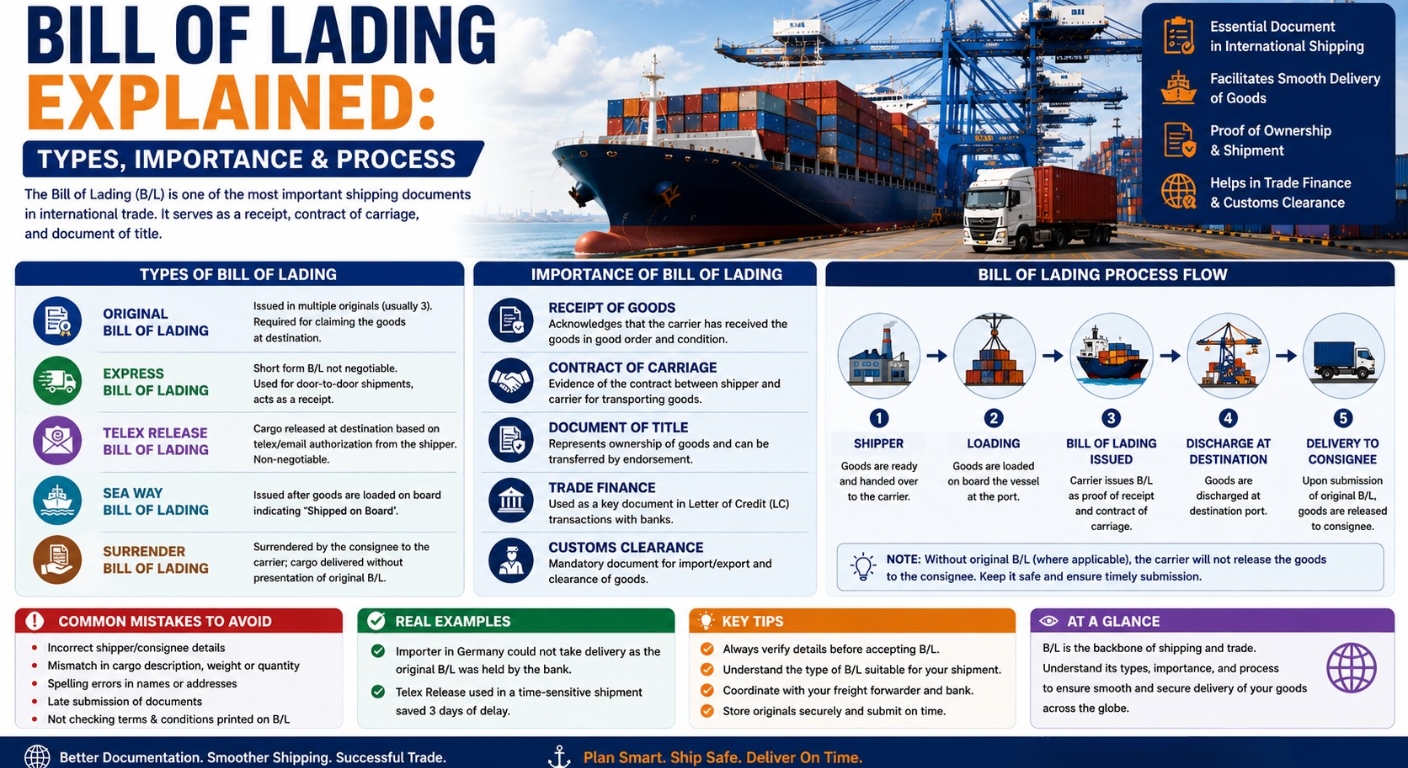
A Bill of Lading (BL) is a legal shipping document issued by the carrier or its authorized agent after cargo has been loaded onboard a vessel. It performs three essential functions.
The first function is that it acts as a receipt of cargo, where the carrier confirms receiving the goods in good condition. For example, it may state that 18 pallets containing automotive spare parts have been received.
The second function is that it serves as a contract of carriage, acting as evidence of the transport agreement between the shipper and the carrier. It defines the origin, destination, freight terms, responsibilities, and carrier liabilities.
The third function is that it acts as a document of title. In the case of Original Bills of Lading, ownership of cargo is transferred through possession of the document, and without it, cargo generally cannot be released.
Parties Involved in a Bill of Lading
A typical Bill of Lading involves several parties, including the shipper, consignee, notify party, carrier, NVOCC if applicable, freight forwarder, and customs broker. Each of these parties plays a defined role throughout the shipping process, ensuring that cargo moves smoothly from origin to destination.
Information Included in a Bill of Lading
A standard Bill of Lading contains important shipment details such as the BL number, vessel name, voyage number, port of loading, port of discharge, place of delivery, shipper details, consignee details, notify party, container number, seal number, number of packages, cargo description, gross weight, measurement in CBM, freight terms, and date of issue. Accuracy in these details is essential because customs authorities also verify this information during clearance.
Types of Bill of Lading
1. Original Bill of Lading (Original BL)
The Original Bill of Lading is the traditional shipping document and is normally issued in three original copies. Cargo can only be released after presentation of at least one original document. It is best used for Letter of Credit shipments, high-value cargo, international trade requiring title transfer, and bank-controlled transactions. Its main advantages include high security, legal ownership transfer, and worldwide acceptance. However, it also has limitations such as courier delays, risk of loss, complicated replacement procedures, and a longer documentation process.
2. Express Bill of Lading (Express BL)
An Express Bill of Lading is issued when no physical Original BL is required. In this case, the carrier releases cargo electronically without requiring document presentation. It is best suited for trusted business partners, repeat shipments, low-risk cargo, and faster deliveries. Its advantages include faster cargo release, no courier costs, and reduced paperwork. However, it cannot be used when banks require Original Bills of Lading.
3. Sea Way Bill
A Sea Way Bill is not a document of title but only proof that the carrier has accepted the cargo. The consignee named in the document can receive the cargo without presenting any original document. It is suitable for parent company shipments, branch office transfers, related companies, and trusted buyers. Its advantages include fast release, lower administrative work, and no courier expenses. However, ownership cannot be transferred during transit.
4. Telex Release
A Telex Release allows cargo delivery without presenting Original Bills of Lading. In this process, the Original BL is issued first, then the shipper submits the originals back to the origin office. The carrier confirms surrender, the destination office receives electronic release instructions, and the cargo is released. It is best used for urgent shipments, cases where original documents are unavailable, or when courier delivery is delayed. Its benefits include faster cargo release, avoidance of courier delays, and reduced demurrage risk.
5. Surrender Bill of Lading
A Surrender Bill of Lading occurs when the shipper returns all Original Bills of Lading to the carrier at origin, after which the carrier stamps them as “Surrendered.” The destination office then releases cargo without requiring the originals. In practice, the terms “Telex Release” and “Surrender BL” are often used interchangeably, although Telex Release refers to the communication process that follows surrender.
Original BL vs Sea Way Bill
The Original Bill of Lading provides document of title, allows ownership transfer, requires physical documents, and is necessary for bank LC shipments, but it also requires courier handling. In contrast, a Sea Way Bill does not provide document of title, does not allow ownership transfer, does not require physical documents, enables electronic cargo release, is usually not suitable for bank LC shipments, and does not require courier services.
Original BL vs Express BL
The Original Bill of Lading involves physical copies, offers high cargo security, requires courier handling, and is generally slower, making it ideal for LC shipments. The Express Bill of Lading does not involve physical copies, offers moderate security, does not require courier services, is faster, and is best suited for trusted customers.
Sea Way Bill vs Telex Release
A Sea Way Bill is issued without any original document and allows direct cargo release. A Telex Release, on the other hand, involves issuance of an Original BL first, followed by surrender of the originals, after which the carrier electronically authorizes cargo release.
Bill of Lading Process (Step-by-Step)
The shipping process begins when the exporter books the shipment. The cargo then reaches the port and is loaded onboard the vessel. The carrier prepares a draft Bill of Lading, which the exporter verifies for accuracy. Once confirmed, the carrier issues the final BL. The documents are then sent to the importer or bank, after which the importer arranges customs clearance, and finally the cargo is released.
Common Bill of Lading Mistakes
One of the most common mistakes is an incorrect consignee name, where even a small spelling error can delay cargo release. Another issue is wrong HS description, which must always match the commercial invoice, packing list, and shipping bill. Errors in container numbers can create customs complications, while incorrect weight may trigger inspections. Late BL confirmation can delay document issuance, and losing the Original BL can require bank guarantees, indemnity bonds, and legal approvals, often delaying delivery by weeks. Incorrect freight terms such as Freight Prepaid or Freight Collect can also lead to payment disputes.
Real Industry Example 1
An exporter in Mundra shipped ceramic tiles to Italy using an Original Bill of Lading. However, the courier carrying the Original BL was delayed by five days, and the vessel arrived before the documents. As a result, the importer could not collect the container, leading to container detention, port storage charges, and delivery delays. The exporter later arranged a Telex Release after surrendering the originals, which allowed cargo release and prevented further costs.
Real Industry Example 2
A pharmaceutical manufacturer exporting from Nhava Sheva to Singapore uses Sea Way Bills for all shipments because both companies belong to the same corporate group. This approach results in faster clearance, zero courier costs, quicker inventory replenishment, and reduced paperwork.
Real Industry Example 3
A textile exporter shipped garments from Chennai to the UK under a Letter of Credit. The bank required three Original Bills of Lading before releasing payment. Without the Original BLs, the payment could not have been processed, highlighting the importance of Original Bills of Lading in documentary credit transactions.
Bill of Lading Checklist
Before approving a Bill of Lading, it is important to verify the shipper name, consignee details, notify party, vessel name, voyage number, port of loading, port of discharge, container numbers, seal numbers, cargo description, package count, gross weight, measurement in CBM, freight terms, marks and numbers, BL type, date of issue, and signature. Reviewing these details carefully can prevent costly shipping delays.
Best Practices
It is important to review BL drafts before issuance and ensure all shipping documents match. The type of Bill of Lading should be decided before shipment, and consignee information must always be confirmed carefully. Sea Way Bills should be used for trusted buyers, while Original Bills of Lading should be used for bank-financed transactions. Maintaining digital copies for records and coordinating closely with freight forwarders or NVOCCs also helps ensure smooth operations.
Internal Links
To strengthen your shipping knowledge, you can explore related topics such as the Complete Guide to Ocean Freight from India, FCL vs LCL Shipping comparison, Export Documentation Checklist for Indian Exporters, and the Complete Guide to NVOCC Shipping in India (2026).
Suggested Images & Infographics
A hero banner can feature a modern cargo vessel at a busy container port with shipping documents and a Bill of Lading overlay, with the text “Bill of Lading Explained: Types, Importance & Process.” Additional infographics can visually explain the functions of a Bill of Lading, compare different types of Bills of Lading, show the step-by-step shipping process, and highlight common BL mistakes.
Frequently Asked Questions
A Bill of Lading or Sea Way Bill is mandatory for almost all international sea shipments. If the Original Bill of Lading is lost, the carrier may require a Letter of Indemnity, bank guarantee, and additional approvals before releasing cargo, which can delay delivery. Cargo can be released without an Original BL if a Sea Way Bill, Express BL, or Telex Release has been arranged according to carrier procedures. A Sea Way Bill is faster and simpler for trusted partners, while an Original BL provides stronger control over ownership. The Bill of Lading is issued by the shipping line, carrier, or authorized NVOCC after cargo is loaded. A House BL is issued by a freight forwarder or NVOCC, while a Master BL is issued by the ocean carrier. A Bill of Lading can also be amended before or after vessel departure depending on carrier policies, though it may involve charges and documentation requirements.
Conclusion
The Bill of Lading is one of the most critical documents in international shipping. It confirms cargo receipt, defines the contractual relationship between shipper and carrier, and in many cases establishes legal ownership of goods. Choosing the correct type of Bill of Lading whether Original BL, Express BL, Sea Way Bill, Telex Release, or Surrender BL depends on payment terms, trading relationships, urgency, and documentation requirements. Understanding these differences and following best practices helps exporters and importers reduce delays, avoid unnecessary costs, and ensure smooth global cargo movement.
If you need expert assistance in selecting the right Bill of Lading type, managing export documentation, or streamlining your international shipping process, our logistics specialists at Jodac Shipping Line are here to help. Contact us today to get personalized support and ensure your cargo moves efficiently, safely, and without delays.