
Newsletters
Stay updated with our latest news, insights, and company updates. Explore our collection of newsletters below.
NVOCC vs Freight Forwarder: Key Differences Every Exporter Should Know
Topic: NVOCC vs Freight Forwarder
Introduction
In the global shipping and logistics industry, choosing the right logistics partner can directly impact your business efficiency and cost. Two commonly used terms NVOCC (Non-Vessel Operating Common Carrier) and Freight Forwarder often confuse exporters.
Understanding the difference between an NVOCC and a freight forwarder is crucial for smooth cargo movement, cost optimization, and risk management. This guide will help exporters clearly understand both roles and choose the right partner for their shipping needs.
What is an NVOCC?
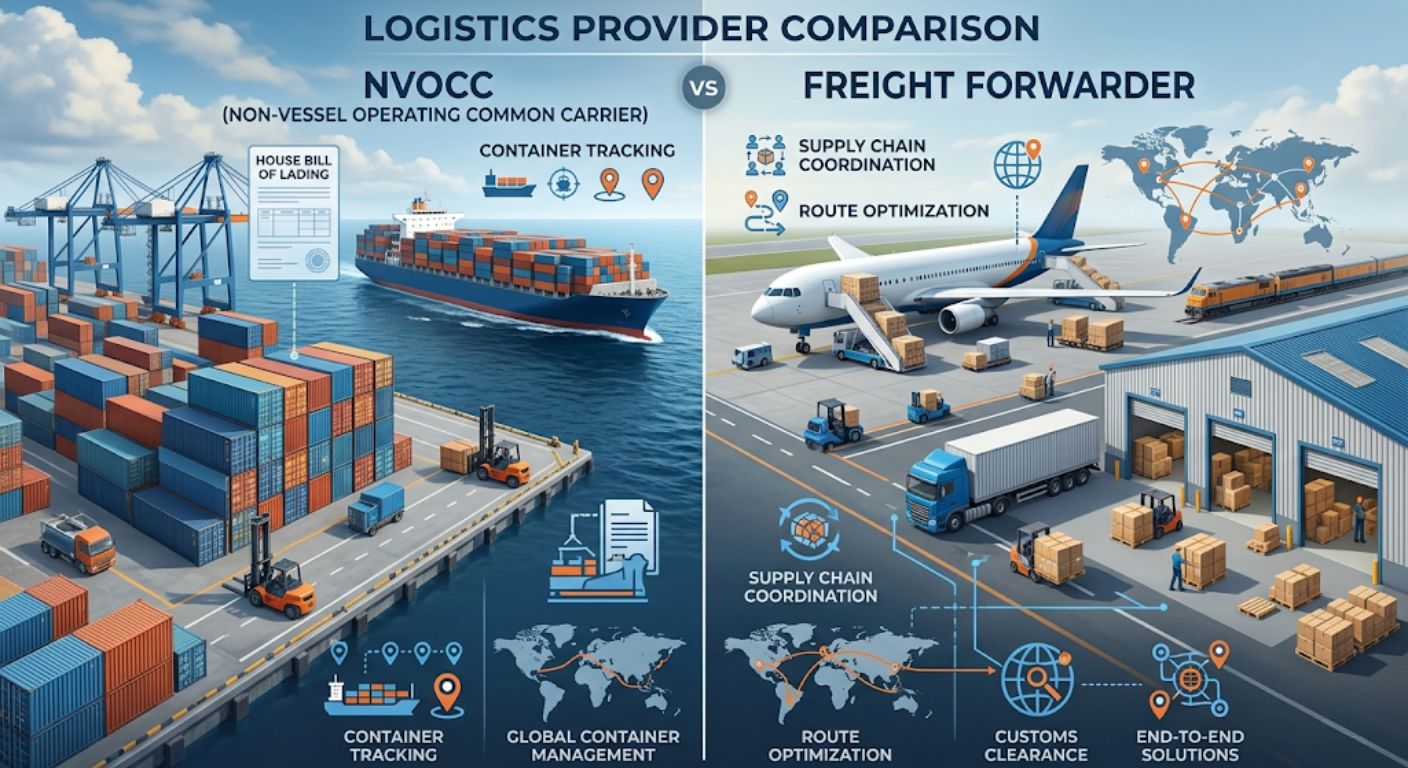
An NVOCC (Non-Vessel Operating Common Carrier) is a company that provides ocean freight services without owning ships. Instead, they lease space from shipping lines and issue their own House Bill of Lading (HBL).
Key Features of NVOCC
- Acts as a carrier to shippers
- Issues its own Bill of Lading
- Offers competitive ocean freight rates
- Consolidates cargo (LCL shipments)
- Takes responsibility for cargo movement
NVOCCs are ideal for exporters looking for reliable ocean freight solutions with better control over shipping documentation.
What is a Freight Forwarder?
A Freight Forwarder is a logistics expert that manages the entire shipping process on behalf of the exporter. They act as an intermediary between the shipper and various transportation services.
Key Features of Freight Forwarder
- Arranges transportation (sea, air, road)
- Handles customs clearance and documentation
- Coordinates with multiple service providers
- Does not issue its own Bill of Lading (in most cases)
- Provides end-to-end logistics solutions
Freight forwarders are best suited for exporters who need complete logistics support from origin to destination.
NVOCC vs Freight Forwarder: Key Differences
| Basis | NVOCC | Freight Forwarder |
|---|---|---|
| Role | Acts as a carrier | Acts as an intermediary |
| Vessel Ownership | Does not own vessels | Does not own vessels |
| Bill of Lading | Issues own Bill of Lading | Usually uses carrier’s Bill of Lading |
| Responsibility | Takes responsibility for cargo | Coordinates shipment |
| Services | Mainly ocean freight | Multi-modal logistics |
| Pricing | Competitive for bulk shipments | Flexible depending on services |
Which One Should Exporters Choose?
Choosing between an NVOCC and a freight forwarder depends on your business requirements:
Choose NVOCC if:
- You deal primarily in ocean freight
- You need cost-effective shipping rates
- You prefer direct carrier responsibility
Choose Freight Forwarder if:
- You need end-to-end logistics solutions
- You require customs clearance support
- Your shipments involve multiple transport modes
Why Understanding the Difference Matters
Many exporters face delays, unexpected costs, or documentation issues due to a lack of clarity between these two roles. By understanding the difference between NVOCC and freight forwarder, you can:
- Reduce shipping risks
- Optimize logistics costs
- Improve supply chain efficiency
- Ensure smoother international trade operations
How Jodac Shipping Line Supports Exporters
At Jodac Shipping Line, we combine the strengths of both NVOCC services and freight forwarding solutions to deliver seamless logistics experiences.
Our expertise ensures:
- Reliable ocean freight solutions
- Efficient cargo handling and consolidation
- End-to-end logistics support
- Transparent documentation and tracking
We help exporters simplify global trade with professional and dependable shipping services.
Conclusion
Understanding NVOCC vs Freight Forwarder is essential for every exporter aiming for efficient and cost-effective logistics. Both play important roles, but selecting the right one depends on your shipping needs.
Partnering with an experienced logistics provider like Jodac Shipping Line ensures your cargo moves safely, efficiently, and on time every time.